Flash Flood Modeling - Haw Watershed
For this project, we were assigned to choose a watershed on the East Coast that was affected by Hurricane Matthew in October 2016. We chose to analyze the Haw Watershed in North Carolina. There are a total of 6 watersheds within the Haw Watershed that we are utilizing for our final flood risk model.
We analyzed precipitation, land cover, soil, and terrain. The land cover can have a huge impact on the way that water will flow when there is a storm surge. For soil, we focused on texture, structure, and hydrologic group dominant condition.
Group Members: Christian Schroeder, Eric Rosenthal, and Jordan Weitzel
Class: Modeling with GIS (GEOG 4084)
Professor: Santosh Rijal
References:
NEXRAD Data Inventory Search. https://www.ncdc.noaa.gov/nexradinv/
NOAA's Weather and Climate Toolkit. https://www.ncdc.noaa.gov/wct/
NOAA PF Data Server. https://hdsc.nws.noaa.gov/hdsc/pfds/

Our final model of the flood risk in areas of the Haw Watershed. We can see that the majority of rain accumulation occurred in the Roberson area. This could be due to the high number of rivers and lakes in the area.
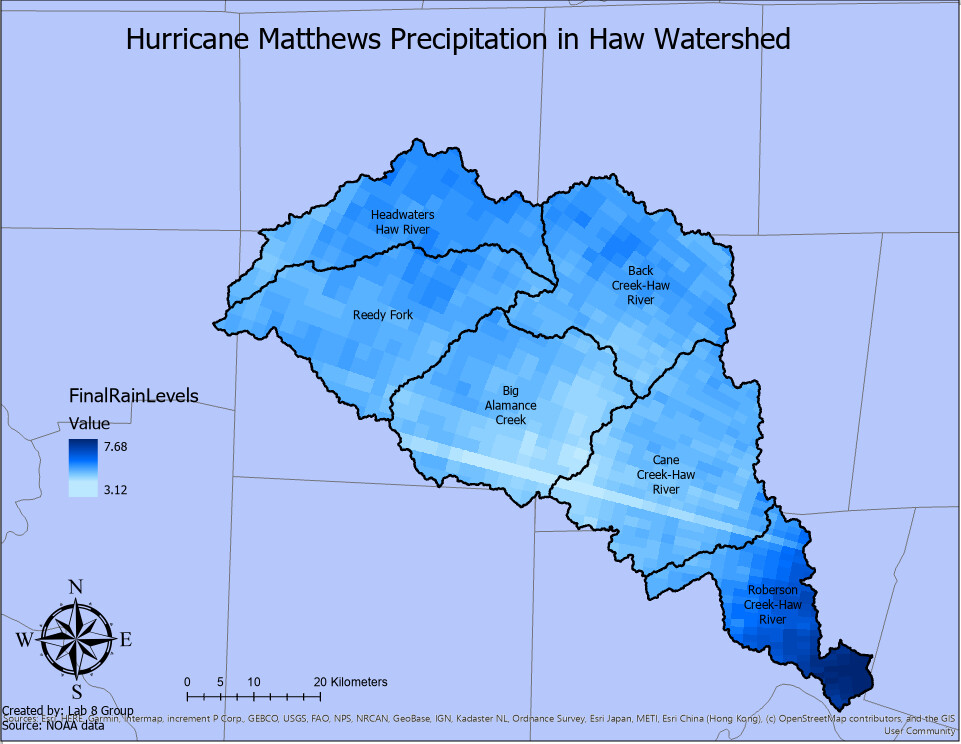
In our rainfall model there were higher levels of water accumulation in the Roberson Creek-Haw River watershed which was the in the Southeast portion of the Haw Watershed.
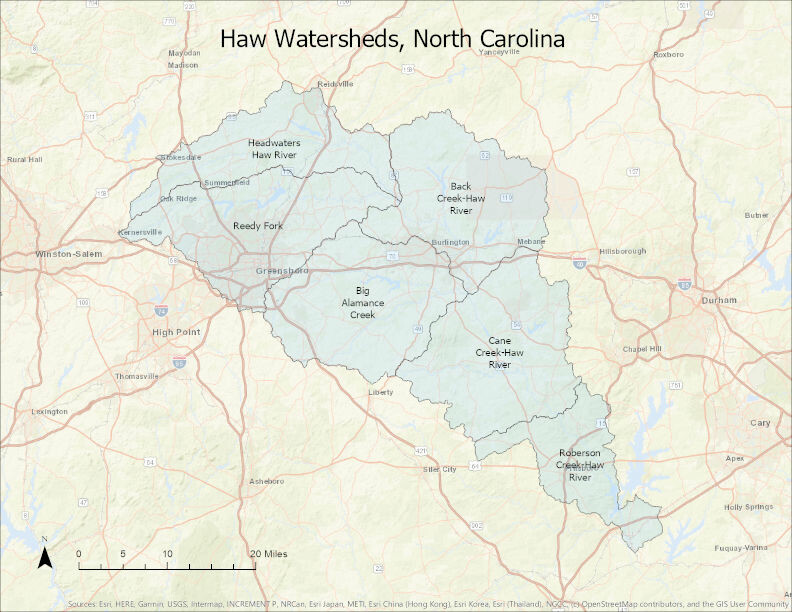
Map of the subdivisions of the Haw Watershed.